
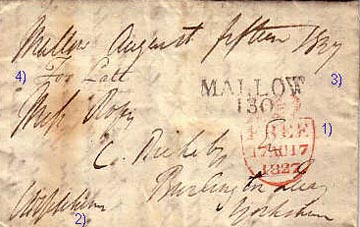
 This
letter comes from Mallow in County Cork, addressed to Miss Rogers, C. Rickaby
Esqr, Burlington Quay, Yorkshire and has some interesting Irish postal markings.
This
letter comes from Mallow in County Cork, addressed to Miss Rogers, C. Rickaby
Esqr, Burlington Quay, Yorkshire and has some interesting Irish postal markings.
 a manuscript notation of
TOO LATE. This would have been applied because the letter was dated by
the Free Frank holder as August fifteen, and the date stamps are both
the 17th.
a manuscript notation of
TOO LATE. This would have been applied because the letter was dated by
the Free Frank holder as August fifteen, and the date stamps are both
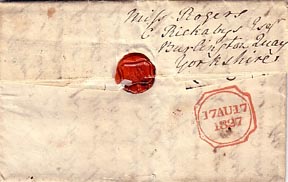
the 17th.An interesting point is that whoever claimed the FREE postage has written in full Mallow August fifteen 1827 at the top (as required by the regulations) — then the address and then signed it illegibly in the bottom left hand corner. However, on the back of the letter that full name and address is written in a different handwriting. So it looks to me as though the person who was entitled to the frank did not actually write the letter, but simply wrote the name and address on the front.
This would be — in theory — a misuse of the franking privilege, but difficult to prove, as long as the writer did not exceed the number of letters sent — which was 10 a day at this time. The privilege was a good money saver because from Mallow to Burlington Quay would have cost a total of 2shillings and 3pence. This would have included the land costs, the Packet charge and bridge charges.
Incidentally, I found a reference in a trade directory of 1819 for a Charles Rickaby Esq at Prince St, Burlington Quay. In a history of the East Riding of Yorkshire written in 1856, it was noted that
"In the Domesday Survey the place is called Bretlinton, and the name has been spelt at various times, Berlinton, Brellington, and Britlington; and away from the town it is now called Burlington, though the Government authorities have within a few years spelt it Bridlington."
The letter was sent by Susan Becher from Clyda, Mallow in County Cork, Ireland on August 14th 1827, and the red wax seal has initials S B The letter is written by two people. It begins :-
"My dearest Mary
We must indeed have the appearance of a most unnatural set of Clyda relations to bear silence so long, particularly after the receipt of your most kind & welcome letter written from Liverpool — appearances I confess are sadly against us but I need not say to you that the name of Mary Rogers & thoughts of her, have been constantly with us. A long letter I wrote to you shortly after hearing from Liverpool still stares me in the face here, but its date is so long past that it is not worth sending; as you may judge I waited for his reverences pen to join me, which he promised & intended to perform, but mens pens are not as womens pens. I suppose I ought to say they are vastly superior — your good father hospitably induced us to visit him with our whole party from Clyda, Uncle, Aunt, Kate, Uncle, Miss Gingen & three bairns — a most happy & cheerful time we spent at Rose Hill a particularly interesting and attachable spot it appeared to me — a perfect shower of Roses, enough to satisfy Moore himself — the children were in delight, & lived out except at meals. Dear Kate was most kind and added to all the comforts which children require, and which are seldom to be procured in a house where children are not, many luxuries which I should not have thought of giving them, — in short they were as country folks say "in clover".
We rejoice most sincerely my dearest Mary in the favourable & delightful accounts Kate gives us of your health I trust you will bring home with you a good store of strength & appetite, the latter being I think quite requisite to the former — you will I know be glad to hear that I am returning a good deal to my ritual habits, driving not too much, a greater distance daily, walking, & dining again with the family at half past 5 — I hope when you return to be able, without staying to consider about it, to take coach & set off to look at you."
The next paragraph is a wonderful account of the family and friends, and would have been most welcome to their friend in Yorkshire.
"Your dear Uncle Mick is I thank God as well as usual, better we need not wish him to be — the three bairns growing fast, Johnnie immense- Annie keeping up to him, my dear Harry as usual a good & dear boy — the two elder learn to dance which I think of use to both, to Harry its prevents the awkwardness which creeps on boys of his age in a drawing room, & it proves in Annie a perfect restoration of strength as she is able to hop on one foot balancing herself, which she could not possibly have done twelvemonths ago — our friend Mrs Becher is in Carbery with her three dear little children. The son & heir is a noble fine creature, delightful to see a child so little likely to be a cause of anxiety to her — before closing this I will write a few lines to Miss Rickaby, believe me, dearest Mary
Ever most affectionately yours
Susan Becher"
The writing then changes, and I have transcribed as it was written. He did not have enough room to finish on the inside page, so rather than 'crossing' his lines, he continued on the outside page, which is folded in for posting, so it would not be visible until the letter was opened. You can see this from the lighter colour of the paper. The writing on the image is shown in bold in the transcription below.
"Clyda Mallow August 14th 1827
My darling Mary
The sun with some of its brightest rays passing through the opening of our shutters awoke me at 5 oclock some mornings of this summer, and my first thoughts were of you, when your aunt askd me when we might soon get a letter from Mary Rogers, and truly the post of the same day brought us one — you will be delighted to hear your Aunt has lately gained much strength and our Doctor assures her she is perfectly restored — the Baylys have appeared in Cork, Helena has announced her arrival to me — and though I do not from the caliber of her understanding, hold her accountable for much, yet I feel I should not do wright in having her here, when she had acted unkindly to her mother, and written undutifully of that mother to me —

Bring home a fair portion of health, but leave behind you the tricks you will pick up at the Yorkshire fairs — Remember us kindly to Miss Rickaby and believe me from your own Uncle
M Becher"
What a marvellous family unity comes through from the letter, and what a cheerful report of conditions in Ireland in 1827.

Clyda House, Mallow
However, in February 2010, I was told about another website for the Becher family of Clyda, and this shows that the surname is Becher, and that the correct family home, Clyda House, is at Kilshannig, near Mallow.I contacted the owner of the website who advised she is descended from the writer of this letter and kindly gave me genealogical details confirming the relationships of the people mentioned in the letter, and gave permission to show the house here. If any viewer would like to be in touch with her, please contact me and I will forward the e-mail. Or you can contact her directly on Becher family

Clyda House, Kilshannig
Although this letter has been up on the web for a few years, anyone searching for Becher would not have found it, as I had transcribed the name as Beehen, and when I did the research for the letter, no other information showed up on the search engines. It is amazing how much more information is being added every day.| Home Page | Letters index page |
Last modified |